Menu
  • Edward S. Curtis
  • Living Artists
  • Andy Warhol
  • Historical Artists
  • Client Installations
  • Blog
  • About Mia Valley
  • Media
  • Contact Valley Fine Art
Valley Fine Art
  • Edward S. Curtis
  • Living Artists
  • Andy Warhol
  • Historical Artists
  • Client Installations
  • Contact
  • Media
  • About Mia Valley
  • Blog
  • Home
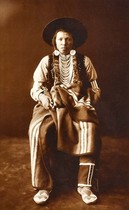
Edward S. Curtis - A Yakima - Gelatin Printing Out Print - 15 x 9 3/4 inches - Gelatin Printing out Prints <br> <br> Gelatin printing out prints (more commonly know as albumen prints) are Curtis’ earliest and scarcest master exhibition prints. This handful of exquisite prints was printed in or proximal to 1900, when Curtis made his watershed journey to the Montana Plains to witness one of the final Piegan Sundances. <br> <br>It is likely Curtis printed these images himself, in sunlight, while on that expedition. No other photographs are as close to Curtis’ own hands. It is believed there are less than 70 surviving examples of this process. Printing out Prints are the most coveted and important photographs Curtis produced. <br> <br>Following you will find noted a distinction to the albumen label. Curtis actually never printed on an albumen paper. We have termed them albumen because the medium has technically been mislabeled and we simply use "albumen" for simplicity and consistency. <br> <br>The early Curtis prints we call "albumen" are actually gelatin printing out prints. The process is exactly the same for either albumen or gelatin printing out prints. The sensitized paper was placed in direct contact with a glass negative and exposed in strong light--usually sunlight. Then, the image formed on the paper while in contact with the negative and during it's exposure to light. The final image was then toned with gold for color and permanence. <br> <br>The difference between albumen prints and gelatin printing out prints is in the papers. In both cases a thin layer of emulsion sits above the paper and contains the light-sensitive silver salts which react with light to form the image. In albumen prints, that emulsion is made from whisked egg whites, and therefore called albumen. In gelatin printing out prints, the emulsion is made from gelatin, which is a starch. Gelatin prints are more stable than albumen prints, because albumen decays very easily in the presence of moisture and light.
Edward S. Curtis

About Us

  • About Mia Valley
  • About Valley Fine Art
  • Contact Valley Fine Art
  • Aspen Art Gallery Blog

Contact Us

Aspen, Colorado 81611
970-920-9193
Email

Get in Touch

FacebookLike Us On Facebook
InstagramLike Us On Instagram

Subscribe to our Newsletter
Privacy Policy

Back to Top
© Copyright 2026 Valley Fine Art.
All Rights Reserved.